

When a Classic Game Teaches Strategic Thinking
How Battleship Builds Logic, Patience, and Systems Awareness at Armitage House
A Seed of Wonder
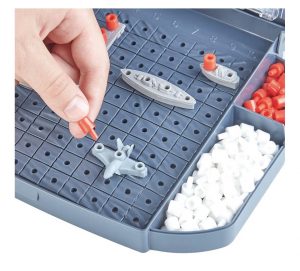
Paying attention to how children concentrate when something truly matters.
Paying attention to the quiet intensity that appears when thinking becomes purposeful.
Paying attention to how play, when respected, becomes one of the deepest teachers of all.
One of those moments unfolded not through noise or excitement, but through silence.
A grid.
A pencil.
A whispered coordinate.
Battleship.
At first glance, Battleship looks simple. Guess and check. Hit or miss. A game of chance.
But when you slow down and observe how a child actually plays, a different story emerges.
You can see strategy forming beneath the surface.
You can see hypotheses being tested.
You can see thinking becoming disciplined.
And that is where Armitage House lives.
From Guessing to Hypothesis: Why Battleship Matters
Long before Armitage House had a name, I was already studying how humans learn. During pregnancy and throughout early childhood, I immersed myself in neuroscience, child development, creativity research, Montessori, Reggio Emilia, and systems thinking.
One truth surfaced again and again.
Children learn best when they are allowed to think like investigators.
Battleship does not reward impulsivity.
It rewards observation.
It invites children to move from guessing to reasoning. From reaction to strategy. From randomness to pattern recognition.
As an industrial engineer, I see Battleship as a closed system. A bounded environment where children can explore uncertainty, probability, spatial reasoning, and decision-making without pressure or consequence.
Every move generates data.
Every response narrows possibilities.
Every game becomes a living experiment.
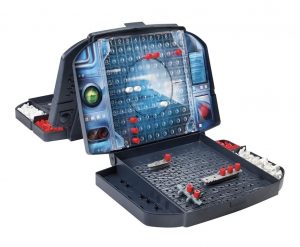
What Battleship Teaches Without Explaining
At Armitage House, we trust learning that emerges naturally.
Battleship quietly teaches children to:
• Form hypotheses and revise them
• Track information over time
• Use logic to eliminate possibilities
• Recognize spatial patterns
• Practice patience and restraint
• Tolerate uncertainty
• Learn from incomplete information
Children begin to understand something profound.
Not all problems reveal themselves immediately.
Not all answers are obvious.
And not all success comes from speed.
This mirrors real science.
Real research.
Real life.
A Game of Precision, Not Luck
Despite appearances, Battleship is not about chance.
It is about disciplined inquiry.
Children must decide where to search. How to space their moves. When to change strategies. When to stay the course. They learn to resist the urge to react emotionally to a miss and instead treat it as information.
This trains:
• sustained attention
• working memory
• emotional regulation
• strategic patience
At Armitage House, we protect this kind of thinking. We design learning experiences that allow children to sit with uncertainty long enough for insight to emerge.
Battleship does exactly that.
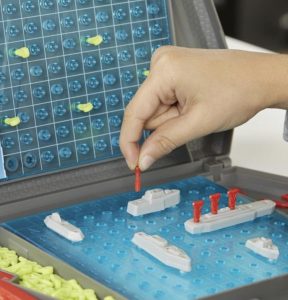
Where Logic Meets Imagination
Battleship is also a narrative game.
There is an unseen world beneath the surface.
Ships hidden.
Clues revealed slowly.
Tension built through silence.
Each game tells a story of discovery.
Children learn that imagination and logic work together. That visualization supports reasoning. That unseen systems can be mapped through careful observation.
This is a core belief at Armitage House.
We do not separate imagination from rigor.
We do not separate play from thinking.
We do not separate joy from discipline.
We integrate them.
Building Confidence Through Strategic Awareness
Battleship builds a very specific kind of confidence.
Not loud confidence.
Quiet confidence.
The confidence that comes from knowing how to think.
When children realize they can gather information, analyze patterns, and make better decisions over time, something shifts internally. They begin to trust their minds. They become more resilient. They engage more deeply.
This is systems thinking at a child’s level.
And it is exactly how scientists, engineers, researchers, and philosophers think.
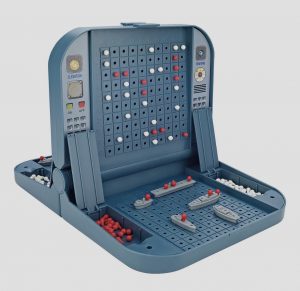
How Battleship Lives Inside Armitage House
At Armitage House, Battleship is never “just a game.”
It becomes:
• A logic and reasoning exercise
• A science conversation about hypothesis testing
• A math exploration of grids, spacing, and probability
• A mindfulness practice in patience and focus
• A systems-thinking laboratory
Sometimes we add constraints:
What if you could only fire in patterns?
What strategy gives the most information?
How do you recover from an inefficient start?
Sometimes we simply observe.
Both matter.
Our Mission, Reflected in a Game
Battleship embodies the heart of Armitage House.
✨ Learning that feels purposeful
✨ Thinking that feels empowering
✨ Curiosity guided by structure
✨ Strategy without pressure
✨ Wonder grounded in clarity
This is what we mean when we say learning should feel like magic.
Because magic is not chaos.
It is understanding revealed through experience.
From Our House to Yours
You do not need elaborate materials to raise thoughtful children. Sometimes all you need is a quiet game, a shared table, and the patience to let thinking unfold.
This is how Armitage House was built.
One observation.
One question.
One moment of wonder at a time.
Battleship reminds us that learning does not need to be fast to be powerful. It needs space, intention, and trust.
And that is what we create here.
A place where play becomes inquiry.
Where inquiry becomes understanding.
And where wonder meets worldwide.
Welcome to Armitage House.



Leave a comment